Clip vs. Magazine
This is probably the least important issue I'll touch on in regards to how firearms impact our lives. I'm putting it first because it's so easy to get right and gun control advocates rarely do. This makes them look silly. Short version- When in doubt, it's a magazine, not a clip. Few if any modern firearms use clips so just say mag or magazine because there's about a 90% chance you'll be right. If you say clip, you have about a 3% chance of being right. That other 7% is made up of revolvers, belt-fed weapons, and single-round weapons.
So what's the difference? Put simply, a clip moves with the cartridges (Or bullets for those of you not worried about being exact.) while a magazine uses a spring or some other device to push the cartridges through the device. Modern weapons (and MANY older ones) use a magazine almost exclusively. Don't say clip, you'll almost certainly sound ignorant.
Here is a decent video about it.
Armor piercing rounds
This mistake happens less often but it's a HUGE issue because it turns normal people into villains. A lot of gun control advocates admit that the right to a firearm for self defense inside the house is acceptable.

The most common round used for home defense is a hollow point or JHP (jacketed hollow point) round. These are designed to spread out on impact and transfer as much energy from the bullet into the target as possible.

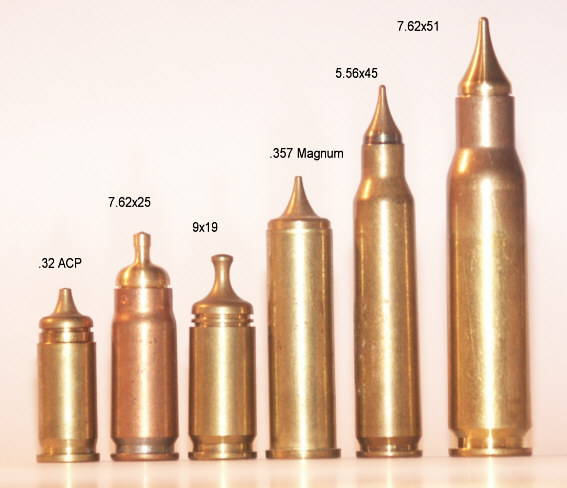
Armor piercing rounds are designed to penetrate armor- metal, composite, fabric... As you can see, they have a fine, pointed tip that concentrates their energy on a very small area.
Why does this matter? The news and the blogosphere frequently obfuscate this by referring to various bullets as "cop killers" or by noting that armor piercing rounds make a gunman more dangerous. The fact of the matter is that each different type of bullet is very useful in some situations and next to useless in others. Against your average burglar wearing sweats or jeans, a hollow point is ideal as it imparts maximum energy on the target. FMJ rounds will do a lot of damage but a higher powered one will go right through a person and possibly through the wall behind them if it doesn't hit something like a bone or a stud. An AP round will almost always go right through something as soft as a person without any fragmentation at all. This means that if you are protecting your house with AP rounds, you are putting your neighbors in danger because the bullet COULD go right through your walls and into your neighbor's house.
Semi-automatic?
There are three basic types of gun in this regard.
1. Standard fire (bolt-action, many shotguns, and the like) weapons can be fired one time per pull of the trigger and between trigger pulls, you must manually reload and re-cock the weapon. Think about the shotguns in most movies. You pull the trigger, you pump it, you pull again...
2. Semi-automatic weapons fire one round per trigger pull but use the recoil of the shot to chamber another round and cock the hammer. This means that you can fire almost as quickly as you can pull the trigger. Think of almost every handgun you've ever seen.
3. Fully automatic weapons are like semi-auto in that they use the recoil to chamber the round and cock the hammer but they will continue to fire if you simply hold the trigger down- think machine guns the army uses.
Confusing semi-auto (at this point, the standard weapon system for civilians) with full-auto weapons (standard system for the military) is a pretty major mistake as semi-auto is common and full-auto is, in the US, illegal for normal citizens to have. Thus there's a pretty big difference between a fully automatic weapon and a semi-automatic weapon from the legal and philosophical standpoint.
While I have VERY strong opinions on firearms ownership (probably not what you think though...), I'm more interested in sharing the knowledge I've gathered with those who want it. We can't have a reasoned debate if people don't actually know what they're saying.

Fully automatic weapons are legal in the united states allbe them hravily restricted. Certain states do not allow them but the vadt majority of states do. They are federally regulated by the ATF and referred to as NFA firearms. To own one, the firearm has to 1) have been manufactured prior to the weapons ban of 1984 and 2) have been registered with the ATF prior to 1984. Given that is now most certainly a short list of available firearms, they tend to be expensive. An M16 such ad the military uses runs about 15-20k. Assuming you have found what is called a "transferrable" FA (full auto) weapon for sale, any civilian with a clean criminal history and the cash can purchase one. The process involves a form which goes to the ATF with fees and a tax certificate is received for the cost of 200 dollars. You may then pickup your paid for NFA item after a 4 to 6 month waiting period and receiving your tax certificate. The waiting period is to process the extensive backgrounf check. That said, it is perfectly legal (in all but a few states) to own am FA weapon but it is extremely cost prohibitive.
ReplyDeleteThank you for the clarification, Ben. I'm a big fan of accurate information so thank you very much for that.
ReplyDeleteNicely done. Feel free to visit GunControlMyths.com and add this as a contribution!
ReplyDelete