Random, discombobulated, but... somehow very important to me.
If we want our country to be a better place, the people running it need to be better people. Not smarter. Not younger. Not "more in touch." Better. They need to be civil servants and they need to know that their job is to make this country grow. Much like a parent needs to know when they have to be the friend and when they have to be the disciplinarian, our government needs to learn that following the whim of the crowd is a sure way to end up exactly where we are now. Debt up to our eyeballs, divided, angry, weak, and bitter.
So. To keep the folks in the legislature in the place they need to be:
1- No elected official (Edited per comments on 2/19 at 1031 PST) will have an income greater than 110% of the median income of their constituents. These people are civil servants first and foremost. They SERVE the people, not lord over them. If there are people in your constituency struggling to put food on their table, you should not be debating your third car on their dime. If the cost of living at the capitol is too high, Uncle Sam can build dorms. Nice, secure, somewhat posh dorms, sure. But dorms. You do not need a brownstone and a limo for the six months you're working when there are people losing their homes in droves electing you.
2- Armed forces will get access to the same insurance plan that congress gets at the same cost. If the people sending our friends and family off to die get amazing health coverage on the public dime, the people actually losing their limbs do too. It's that simple. There is exactly zero logical or emotional way of supporting the idea that men and women in suits in some of the most protected buildings in the country have better healthcare than the men and women we send overseas to fight and die in our names. That has to stop right now. RIGHT NOW.
3- When your job ends, so do your benefits. I've been in the corporate world for a decade now. I've changed jobs a number of times. I've yet to continue getting paid, insured, or compensated by an employer after leaving the company. Time for our government to be "of the people" again and realize that when you leave your job, it's over. You don't get a pension for four years of service. You don't get health insurance on the public dime for the rest of your life. You are one of us, you live like one of us. You cannot legislate for your constituents if you are unable to grasp the situation we are in.
4- Barring top secret/high clearance work, every meeting, every committee, every governmental email, every document and every version of every bill is public. You work for us. We pay your salary. We buy your computers, cars phones, and everything else you use for your living. Your entire job is to work to make our country a better place. My employer makes me sign a notice that my data is theirs. Your data is ours. You make good money- go buy a private cell phone if you want to send dick pictures, flirt with pages, or tell your bros how many of our jobs you'll trade for a vote on your bill.
5- There will be no more than two people (or twenty percent, whichever is smaller) on a committee who are not well-versed on the subject of the bill. If you have no background in education, you do not debate the merits of standards-based curricula. If you have never been trained in the use of a firearm, you do not debate the merits of firearms training. If you have no medical background, you do not debate... You get the idea. There is no reason for people with no background in science or in education to be debating science education. It's detrimental. Stop it.
More to come but if I ever run for office, I'm gonna have a weird platform.
Tuesday, February 19, 2013

Friday, December 28, 2012
The high-capacity magazine
In light of a few discussions regarding firearms, I've found another bit of contentious information in the "news." This post has some opinion but is mostly fact- I'll try to note when I am making a judgement rather than stating a fact.
Several stories and Feinstein's newly proposed bill both call out high capacity magazines (HCMs from here on) as a threat to address in our struggle with gun violence.
The idea that the lawmakers and anti-gun folks have is that if we put an arbitrary 10-round limit on the size of a magazine, we will somehow make mass murders like Colorado and Sandy Hook less possible. The idea is that if the evildoer has to change mags, they lose shooting time, get distracted, stop shooting... either way they are firing fewer bullets. So why is this solution nothing more than hot air intended to look as though they are doing their jobs without actually doing anything?
In short, high-capacity magazines aren't a notable threat. Yes, they make a tiny difference in how fast you can fire off large numbers of rounds if they work correctly. No, they do not make any genuine difference in the level of danger from an evildoer- they may even reduce that danger by increasing the likelihood of a catastrophic weapon failure or a difficult jam.
Several stories and Feinstein's newly proposed bill both call out high capacity magazines (HCMs from here on) as a threat to address in our struggle with gun violence.
The idea that the lawmakers and anti-gun folks have is that if we put an arbitrary 10-round limit on the size of a magazine, we will somehow make mass murders like Colorado and Sandy Hook less possible. The idea is that if the evildoer has to change mags, they lose shooting time, get distracted, stop shooting... either way they are firing fewer bullets. So why is this solution nothing more than hot air intended to look as though they are doing their jobs without actually doing anything?
1- Reloads are FAST.
Swapping the magazine out of a pistol is a snap. The entire reason the modern magazine was invented was to make reloading fast. Older firearms were a single shot- pour some powder down the barrel, tamp with a rod, add the shot and wad, tamp with the rod again, then you could fire. We made the cartridge (What most of you think of as a bullet is a cartridge- casing, powder, primer and bullet in one) to make that faster to use but you still fired a round, pulled back the bolt, loaded a new round and so on. Next we made the clip and stripper clip for guns with built-in magazines. Then we evolved to chain, belt, and magazine-fed weapon systems. All of this evolution has led has to the point where an experienced/trained marksman can be ready to fire before the magazine hits the ground from a reload. A normal person with minimal training can have the next shot fired in less than 7 seconds. This is not enough time to make a noticeable difference.2- HCMs are more prone to jamming.
A magazine is a frame or carrier with a spring inside it to press the cartridges into the chamber when you reload the weapon. The longer that spring is, the less force it can apply at the top relative to when it is fully compressed. In order to balance these needs, HCMs end up with weak, unreliable springs that are more likely to jam your weapon. When you are out of ammunition, a magazine change is nearly reflexive and VERY fast. When it jams unexpectedly, it is disorienting and often requires a concerted effort to fix. Frankly, HCMs are better for the victims as it increases the likelihood of the shooter's weapon being disabled.3- HCMs are harder to use.
The larger the magazine, the harder it is to conceal and handle. It is heavier, it is bulkier, it is harder to disguise. If an evildoer is trying to be discreet, HCMs are detrimental to this goal. In the case of handguns, the HCMs can impact aiming and handling the gun as they are carefully designed with specific ergonomics. Changing away from their design can have major negative impact.In short, high-capacity magazines aren't a notable threat. Yes, they make a tiny difference in how fast you can fire off large numbers of rounds if they work correctly. No, they do not make any genuine difference in the level of danger from an evildoer- they may even reduce that danger by increasing the likelihood of a catastrophic weapon failure or a difficult jam.
Wednesday, December 19, 2012
Firearm education part 1
In the wake of the Sandy Hook tragedy, people have taken to the intarwebs armed with their talking points. Talking heads have babbled about things they don't understand and the populace at large has latched on to a few too many parts of that babble. Without taking a side on the gun control argument, I want to help out those of you who don't understand even the basics of firearms. Why? Because if we want to have a conversation about this, we need to know what we're talking about. No matter how valid your stance on the issue is, if you sound like an idiot, nobody will take you seriously.
Clip vs. Magazine
This is probably the least important issue I'll touch on in regards to how firearms impact our lives. I'm putting it first because it's so easy to get right and gun control advocates rarely do. This makes them look silly. Short version- When in doubt, it's a magazine, not a clip. Few if any modern firearms use clips so just say mag or magazine because there's about a 90% chance you'll be right. If you say clip, you have about a 3% chance of being right. That other 7% is made up of revolvers, belt-fed weapons, and single-round weapons.
So what's the difference? Put simply, a clip moves with the cartridges (Or bullets for those of you not worried about being exact.) while a magazine uses a spring or some other device to push the cartridges through the device. Modern weapons (and MANY older ones) use a magazine almost exclusively. Don't say clip, you'll almost certainly sound ignorant.
Here is a decent video about it.
Armor piercing rounds
This mistake happens less often but it's a HUGE issue because it turns normal people into villains. A lot of gun control advocates admit that the right to a firearm for self defense inside the house is acceptable.

The most common round used for home defense is a hollow point or JHP (jacketed hollow point) round. These are designed to spread out on impact and transfer as much energy from the bullet into the target as possible.
 A normal FMJ (full metal jacket) round can go right through soft things like muscle and keep most of their energy for themselves which defeats their purpose in a defense situation. They are cleaner to fire and cheaper and are thus the preferred round for target practice and shooting ranges

Armor piercing rounds are designed to penetrate armor- metal, composite, fabric... As you can see, they have a fine, pointed tip that concentrates their energy on a very small area.
Why does this matter? The news and the blogosphere frequently obfuscate this by referring to various bullets as "cop killers" or by noting that armor piercing rounds make a gunman more dangerous. The fact of the matter is that each different type of bullet is very useful in some situations and next to useless in others. Against your average burglar wearing sweats or jeans, a hollow point is ideal as it imparts maximum energy on the target. FMJ rounds will do a lot of damage but a higher powered one will go right through a person and possibly through the wall behind them if it doesn't hit something like a bone or a stud. An AP round will almost always go right through something as soft as a person without any fragmentation at all. This means that if you are protecting your house with AP rounds, you are putting your neighbors in danger because the bullet COULD go right through your walls and into your neighbor's house.
Semi-automatic?
There are three basic types of gun in this regard.
1. Standard fire (bolt-action, many shotguns, and the like) weapons can be fired one time per pull of the trigger and between trigger pulls, you must manually reload and re-cock the weapon. Think about the shotguns in most movies. You pull the trigger, you pump it, you pull again...
2. Semi-automatic weapons fire one round per trigger pull but use the recoil of the shot to chamber another round and cock the hammer. This means that you can fire almost as quickly as you can pull the trigger. Think of almost every handgun you've ever seen.
3. Fully automatic weapons are like semi-auto in that they use the recoil to chamber the round and cock the hammer but they will continue to fire if you simply hold the trigger down- think machine guns the army uses.
Confusing semi-auto (at this point, the standard weapon system for civilians) with full-auto weapons (standard system for the military) is a pretty major mistake as semi-auto is common and full-auto is, in the US, illegal for normal citizens to have. Thus there's a pretty big difference between a fully automatic weapon and a semi-automatic weapon from the legal and philosophical standpoint.
While I have VERY strong opinions on firearms ownership (probably not what you think though...), I'm more interested in sharing the knowledge I've gathered with those who want it. We can't have a reasoned debate if people don't actually know what they're saying.
Clip vs. Magazine
This is probably the least important issue I'll touch on in regards to how firearms impact our lives. I'm putting it first because it's so easy to get right and gun control advocates rarely do. This makes them look silly. Short version- When in doubt, it's a magazine, not a clip. Few if any modern firearms use clips so just say mag or magazine because there's about a 90% chance you'll be right. If you say clip, you have about a 3% chance of being right. That other 7% is made up of revolvers, belt-fed weapons, and single-round weapons.
So what's the difference? Put simply, a clip moves with the cartridges (Or bullets for those of you not worried about being exact.) while a magazine uses a spring or some other device to push the cartridges through the device. Modern weapons (and MANY older ones) use a magazine almost exclusively. Don't say clip, you'll almost certainly sound ignorant.
Here is a decent video about it.
Armor piercing rounds
This mistake happens less often but it's a HUGE issue because it turns normal people into villains. A lot of gun control advocates admit that the right to a firearm for self defense inside the house is acceptable.

The most common round used for home defense is a hollow point or JHP (jacketed hollow point) round. These are designed to spread out on impact and transfer as much energy from the bullet into the target as possible.

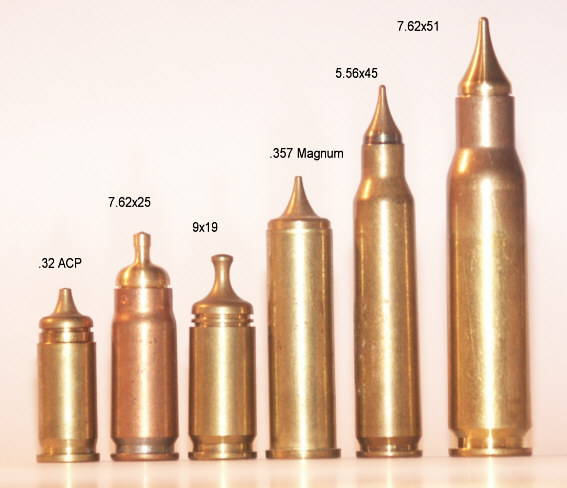
Armor piercing rounds are designed to penetrate armor- metal, composite, fabric... As you can see, they have a fine, pointed tip that concentrates their energy on a very small area.
Why does this matter? The news and the blogosphere frequently obfuscate this by referring to various bullets as "cop killers" or by noting that armor piercing rounds make a gunman more dangerous. The fact of the matter is that each different type of bullet is very useful in some situations and next to useless in others. Against your average burglar wearing sweats or jeans, a hollow point is ideal as it imparts maximum energy on the target. FMJ rounds will do a lot of damage but a higher powered one will go right through a person and possibly through the wall behind them if it doesn't hit something like a bone or a stud. An AP round will almost always go right through something as soft as a person without any fragmentation at all. This means that if you are protecting your house with AP rounds, you are putting your neighbors in danger because the bullet COULD go right through your walls and into your neighbor's house.
Semi-automatic?
There are three basic types of gun in this regard.
1. Standard fire (bolt-action, many shotguns, and the like) weapons can be fired one time per pull of the trigger and between trigger pulls, you must manually reload and re-cock the weapon. Think about the shotguns in most movies. You pull the trigger, you pump it, you pull again...
2. Semi-automatic weapons fire one round per trigger pull but use the recoil of the shot to chamber another round and cock the hammer. This means that you can fire almost as quickly as you can pull the trigger. Think of almost every handgun you've ever seen.
3. Fully automatic weapons are like semi-auto in that they use the recoil to chamber the round and cock the hammer but they will continue to fire if you simply hold the trigger down- think machine guns the army uses.
Confusing semi-auto (at this point, the standard weapon system for civilians) with full-auto weapons (standard system for the military) is a pretty major mistake as semi-auto is common and full-auto is, in the US, illegal for normal citizens to have. Thus there's a pretty big difference between a fully automatic weapon and a semi-automatic weapon from the legal and philosophical standpoint.
While I have VERY strong opinions on firearms ownership (probably not what you think though...), I'm more interested in sharing the knowledge I've gathered with those who want it. We can't have a reasoned debate if people don't actually know what they're saying.
Subscribe to:
Posts (Atom)